


Telescopic belt conveyor is an important tool with a very wide range of uses, mainly used for truck loading and unloading. It is powerful and flexible to operate. Using it can not only help many industries improve work efficiency, but also save a lot of labor costs. Friends who have needs, come and consult and learn more!
What is a telescopic belt conveyor?
A telescopic belt conveyor, also known as a telescopic belt conveyor, is a type of conveying equipment with a telescopic structure, primarily used to allow for flexible adjustment of the conveying length of goods. It is widely used in logistics, warehousing, express delivery, docks, workshops, and other environments, and is particularly suitable for environments where efficiency and convenience in loading and unloading are paramount.
This equipment typically consists of multiple nested, sliding structures. An electric or hydraulic control system allows for automatic or semi-automatic extension and retraction of the belt conveyor sections, allowing for adjustment of length based on operational needs. It also supports lifting and lowering, enabling a wider range of applications.
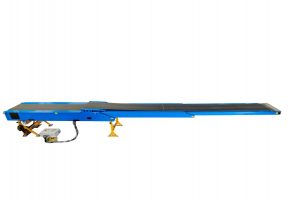
Introduction to Telescopic Belt Conveyor Belt Types and Materials
The belt material of a telescopic belt conveyor directly affects its wear resistance, load capacity, service life, and suitability for different cargoes. Common belt types and materials include:
| Belt Type | Material | Features | Typical Use Cases |
| PVC Conveyor Belt | Polyvinyl Chloride | Anti-static, smooth surface | General cargo handling |
| PU Conveyor Belt | Polyurethane | Food-grade, abrasion-resistant | Light-duty logistics, food transport |
| Rubber Conveyor Belt | Synthetic Rubber | High friction, durable | Heavy-duty applications |
| Teflon Belt | PTFE | Heat-resistant, non-stick | High-temperature materials |
| Modular Plastic Belt | Polypropylene | Easy to clean, customizable structure | Wet or washdown environments |
Belt thickness generally ranges from 2-5mm and is adjusted based on load and conveying speed. Some high-end equipment uses food-grade or environmentally friendly belts to meet specific industry requirements.
Telescopic Belt Conveyor Load Capacity and Width Explaining
The volume of cargo and the width of the belt determine the suitability of a telescopic conveyor. Common specifications are as follows:
Capacity for Load: The typical load on each belt is between 20kg/m and 100kg/m, which is determined by the tension of the belt and the support strength of the roller.
Belt Width: Common belt widths are 500mm, 600mm, 800mm, and 1000mm, with different specifications chosen for different industries.
Length Range: 4m-8m when retracted, and can be extended to a maximum of 12m-20m.
Speed: The variable frequency is adjustable, ranging from 0.2 to 0.6 meters per second, and can be based on the material’s handling needs.
Telescopic Belt Conveyor Benefits
Telescopic conveyors of the belt type have a variety of practical benefits that enhance the efficiency and safety of the process:
Automatic Telescope: It has a electric motor, which allows for easy and quick expansion and retraction with just one button.
Height Additions: Some units have a hydraulically assisted lift that can be used to increase or decrease the platform’s height:loading and unloading.
Forward and Reverse Operation: Allowed for bidirectional movement, this is ideal for both loading and unloading.
Control distance: High-end models have a remote control or touch panel that allows for more convenient operation.
Safety: featuring safety features like an emergency stop button, limiters, and anti-shred features.
Multiple-stage telescopic structure: It’s available in two, three, or four stages, with a variety of configurations and options.

The capabilities of telescopic conveyors in terms of transportation
This equipment has several significant functions in practical applications:
Increasing the efficiency of loading: Significantly reducing the manual distances involved inloading and unloading, reducing costs of labor.
Warehousing processes: Having automated warehouses and transportation vehicles increases the automation.
Operating Safety: The telescopic function decreases the probability of accidents and strains during laborious operations. Increase the efficiency of space utilization: The equipment can be retracted following the completion of the operation, which saves the space of theworkshop.
Reduce operating expenses: Reduce the cost of labor, increase the speed of loading and unloading, and improve the overall efficiency of the system.
What sorts of telescopic conveyors are appropriate for?
Telescopic conveyors with belts are appropriate for a variety of industries and purposes, including but not limited to:
Express delivery center: Highly effective loading and unloading of packages.
E-commerce warehouse: It’s commonly utilized in scenarios that have thousands of daily orders.
Logistics distribution stations: Facing vehicles with assembly lines.
manufacturing factories: Operations that load and unload substances in industries like electronics, clothing, and food.
Docks and ports: Cused of handling cargo in containers.
Large supermarkets and distribution centers: Facing problems with the rapid loading and unloading of bulk cargo.
What is the difference between telescopic belt conveyors and conventional conveyors?
| Project | Telescopic belt conveyor | Ordinary conveyor |
| Is it scalable | yes | no |
| Installation area | Flexible and retractable to save space | Fixed, takes up a large area |
| Applications | Loading and unloading, workshop circulation, terminal operations, etc. | Material handling within the factory |
| Operation | One-button control, support remote control | Mostly manual start and stop |
| Cost investment | Slightly higher | Relatively low |
| Frequency and efficiency of use | High, significant efficiency improvement | Relying on manual labor, the efficiency is average |
| Security | High, with multiple protection systems | Depends on configuration |
Telescopic Belt Conveyor Operation and Maintenance Advice
Recommendations:
Before surgery, make sure the power supply and emergency stop buttons are working as intended.
Ensure that there are no obstacles standing in the way of the telescopic procedure.
Start the machine and then start the belt in the same sequence as it would be loaded. This will avoid having to operate the machine at high speed when it’s unloaded.
Watch the safety margin while using the remote control or control panel to operate the telescopic conveyor.
Daily Maintenance:
Clean the belt’s surface regularly to avoid the accumulation of dust that negatively affects the friction.
Examine the roller and bracket’s connections for flexibility.
lubricate the bearings that support the drive and the chain in order to avoid jamming.
Examine the electronic controller for evidence of circuit wear every 4 months.
Cease the process of inspection and remaking if any unusual noise or vibrations are encountered.
Frequently Asked Questions About Telescopic Belt Conveyors
- What is the telescopic length? Is the height adjustable?
It can typically be extended to 12-20 meters, and some models feature hydraulic height adjustment to accommodate different platforms.
- How long does it take to load and unload a truckload?
Depending on the size of the truck and the amount of cargo, it typically takes 8-15 minutes, significantly improving efficiency. 3. Can it transport goods in a variety of packaging formats?
Yes, it can transport cartons, woven bags, express parcels, and more, as long as the bottom surface is stable.
- Is it easy to operate? Can it be operated by one person?
Very convenient. Equipped with one-touch control and remote control, a single person can perform both retraction and conveying operations.
- Does it have a remote control/control panel?
Most mid-range and high-end models feature intelligent control systems that can be operated by remote control or touchscreen.
- Can it operate in forward and reverse directions?
Yes, the belt supports forward and reverse switching, making it convenient for loading and unloading.
Conclusion
Telescopic belt conveyors, as an indispensable piece of equipment in modern logistics and manufacturing, are gradually replacing traditional fixed conveyors with their flexible retraction, convenient operation, labor-saving features, and improved efficiency. They are widely used in warehousing, express delivery, e-commerce, manufacturing, and other fields. For businesses, choosing the right model and paying attention to routine maintenance can not only improve operational efficiency but also gain an advantage in the fiercely competitive market. If you are looking for a conveying equipment that improves handling efficiency and optimizes warehousing processes, the telescopic belt conveyor is undoubtedly an efficient solution worthy of your consideration.
