


The global logistics industry is increasingly demanding faster, more accurate, and safer cargo handling. With warehouses, distribution centers, and manufacturing plants handling millions of packages daily, loading dock conveyor systems have become indispensable. For companies like Guanchao seeking an efficient loading dock conveyor supplier, the choice isn’t just about purchasing the equipment; it also requires consideration of its long-term efficiency and adaptability, as well as its compliance with international safety standards.
This article will discuss what a loading dock conveyor is, its applications, the materials that go into their making, and performance benefits along with key considerations to factor in while selecting a supplier. Industry FAQs will also be addressed here besides providing an outline that helps logistics, warehousing, and manufacturing practitioners who are at various decision-making levels invest wisely.
What Is a Loading Dock Conveyor?
A loading dock conveyor is a type of conveyor system specifically designed to assist in the movement of goods from trucks, containers, or trailers into any loading dock area. Since it will be used for very heavy applications involving regular loading and unloading, the general-purpose conveyors do not typically fall under this definition.
Typical configurations include:
- Telescopic conveyors: Extendable belts that can go inside the trailer for handling packages rapidly.
- Fixed belt conveyors: These are permanently set up systems designed for continuous high volume operations.
- Flexible or modular conveyors are portable designs that can easily adapt to various dock layouts.
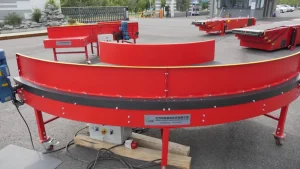
Main Functions of Loading Dock Conveyors
The core role of a loading dock conveyor supplier is to deliver systems that achieve measurable improvements in warehouse operations. The primary functions include:
- Streamlining loading/unloading: Reduces manual lifting and walking distance.
- Time efficiency: Speeds up the transfer process compared to manual labor.
- Safety improvement: Minimizes risks of worker injury caused by repetitive lifting.
- Cargo protection: Ensures smooth handling of cartons, sacks, pallets, or irregular items.
- Integration: Works seamlessly with forklifts, AGVs, and warehouse management systems.
Key Application Areas
Loading dock conveyors are used across multiple industries, particularly in operations where high throughput and frequent truck turnaround are essential.
- E-commerce fulfillment centers
- Retail distribution warehouses
- Third-party logistics (3PL) providers
- Food and beverage industry
- Pharmaceutical and healthcare logistics
- Automotive supply chain hubs
- Air cargo and seaport terminals
Common Materials Used in Loading Dock Conveyors
When selecting a loading dock conveyor supplier, material choices matter for performance and longevity. Common conveyor belt and frame materials include:
- Rubber-coated belts: Provide grip and durability.
- PVC belts: Lightweight, cost-effective, resistant to moisture.
- PU (polyurethane) belts: Offer abrasion resistance and hygiene benefits for food-grade use.
- Stainless steel frames: Used in heavy-duty or hygienic environments.
- Aluminum frames: Lightweight, corrosion-resistant, and modular.
How Much Efficiency Do Loading Dock Conveyors Add?
Efficiency improvements vary depending on the system type, load type, and warehouse workflow. On average:
- Manual handling: Workers typically load 60–80 packages per hour.
- With conveyors: A telescopic conveyor can handle 300–500 packages per hour.
- Overall gain: Efficiency increases of 3x to 6x are common, significantly reducing labor costs and truck dwell time.
Can They Handle Multiple Cargo Types?
Yes. A high-quality loading dock conveyor supplier typically offers systems suitable for:
- Boxed goods: Cartons, crates, and cases.
- Bagged products: Grain sacks, cement bags, fertilizers.
- Loose or irregular items: Bundled textiles, tires, or non-standard packages.
- Palletized goods: With heavy-duty belt or roller systems.
The adaptability of the conveyor is one of its biggest strengths, making it a multi-purpose investment.

Industries with Highest Demand
The demand for loading dock conveyors is driven by industries that rely on fast turnover and consistent throughput:
- E-commerce and parcel delivery – Highest adoption rate.
- Retail distribution – Handles both inbound stock and outbound shipments.
- Food and beverage – Requires conveyors with hygienic and anti-contamination features.
- Pharmaceutical logistics – Needs high compliance with safety and tracking standards.
- Automotive supply chain – Heavy components require robust conveyors.
Load Capacity and Wear Resistance
The performance of a loading dock conveyor is measured by load-bearing capacity, abrasion resistance, and cycle durability.
- Load capacity: Light-duty conveyors handle up to 50 kg per unit, while heavy-duty belts can manage over 200 kg.
- Wear resistance: High-grade PU or rubber belts can operate continuously with minimal wear.
- Lifespan: Quality conveyors can last 8–12 years with proper maintenance.
How to Select the Right Loading Dock Conveyor Supplier
When choosing a supplier, businesses should evaluate multiple factors:
- Customization capability – Can they design conveyors for unique dock layouts?
- Material quality – Do they use industrial-grade belts and corrosion-resistant frames?
- Safety standards – Compliance with CE, ISO, OSHA, or regional norms.
- Technology integration – Automation, IoT monitoring, and compatibility with WMS systems.
- After-sales service – Availability of spare parts, maintenance support, and training.
- Cost-performance balance – Long-term ROI over upfront savings.
Comparison Table: Conveyor Features to Consider
| Feature | Basic Conveyor System | Advanced Conveyor System (Telescopic/Automated) |
| Cargo Compatibility | Boxes, light goods | Boxes, bags, pallets, irregular items |
| Load Capacity | 50–80 kg | 100–200+ kg |
| Efficiency Improvement | 2–3x faster than manual | 5–6x faster than manual |
| Adjustability | Limited | Extendable, height-adjustable, multi-direction |
| Safety Features | Basic guards | Emergency stop, anti-slip, overload protection |
| Integration | Minimal | Forklift, AGV, automation, WMS connectivity |
| Lifespan | 5–7 years | 8–12 years |
| Cost | Low | Medium to high |
Loading Dock Conveyor FAQs
- Do conveyors support telescopic extension and height adjustment?
Yes, most advanced systems allow extension up to 15–20 meters with adjustable heights to match different vehicle sizes.
- What safety standards apply to conveyors?
International standards include ISO 5048, CE certification, OSHA workplace safety guidelines, and in some regions, ANSI B20.1.
- What is the average lifespan and maintenance cycle?
A well-maintained conveyor lasts 8–12 years. Belts may require replacement every 2–4 years depending on usage intensity.
- Is installation and maintenance convenient?
Yes. Modern suppliers design modular conveyors for quick installation and minimal downtime during maintenance.
- How often should parts be replaced?
Belts: 2–4 years
Bearings/rollers: 3–5 years
Control systems: 7–10 years
- Are there anti-slip, waterproof, or oil-resistant options?
Yes. Many suppliers offer specialized belts with anti-slip surfaces, oil-resistant coatings, and water-proof materials for demanding industries.
- Can conveyors be customized in length, width, and material?
Absolutely. Leading suppliers provide customized conveyor lengths (6–20m), widths (400–1000mm), and frame materials (steel, aluminum, stainless steel).
- Are conveyors compatible with forklifts, AGVs, and automated warehouses?
Yes. Advanced systems are designed for seamless integration with forklifts, robotic AGVs, and warehouse automation platforms.
Conclusion
Choosing a supplier for loading dock conveyors is not an exercise in equipment shopping but one in ensuring productivity, safety, and scalability of logistics operations. Warehouses attain 5–6 times higher throughput with the right conveyor system, eliminating worker fatigue as well as keeping safety standards consistent. Informed decisions based on material choice, adaptability, safety certifications, and after-sales support ensure long-term value for businesses.
In the fast-changing logistics market, a dependable supplier is not only viewed as a vendor but also considered to be an integral strategic partner. For businesses planning growth in 2025 and beyond, investing in high-performance loading dock conveyors will not be seen as an option, but rather as a necessity.
